Wednesday, November 11, 2015

Therapy for Postural Tachycardia Syndrome (PoTS) in Malaysia

What is PoTS?

  • Postural          position of the body
  • Tachycardia   increased heart rate
  • Syndrome     a combination of symptoms

Postural tachycardia syndrome is an abnormality of the functioning of the autonomic (involuntary) nervous system. To be diagnosed with PoTS, an individual must experience a group of symptoms in the upright position (usually standing) that are relieved by lying down. A persistent increase in heart rate of 30 beats per minute (40 bpm if under 19 years of age) should be recorded within ten minutes of standing. Blood pressure (BP) does not always drop in PoTS.
Patients can be very disabled by their symptoms.  Fortunately, for many patients, symptoms will improve with a combination of life style changes and medication.  However some will have problems over many years.
Many health care professionals do not know that PoTS exists and so may not think of the diagnosis.  If you think you may have this condition, it may help to take a printout of information from this website to your appointment.


The Postural Tachycardia Syndrome (PoTS) is an abnormality of the autonomic nervous system (sometimes called ‘dysautonomia’). The autonomic nervous system (ANS) is in charge of all bodily functions that we don’t have to think about, such as:
  • Heart rate and blood pressure regulation
  • Digestion
  • Bladder control
  • Sweating
  • Stress response
The sympathetic nervous system is part of the autonomic nervous system. It produces the ‘fight or flight’ or ‘stress’ response. When activated, a chemical called norepinephrine is released. Amongst other things, this causes an increase in heart rate and blood pressure.

Treatment for PoTs  in Malaysia?
The Autonomic Nervous System has two branches, the Sympathetic and the Parasympathetic, which regulate the involuntary processes of the body, the viscera, and sense organs, glands and blood vessels. In evolutionary terms it is older than the CNS and its anatomical circuitry is broadly dispersed, creating a general response, quite unlike the highly specific pathways and response of the CNS. This generalised, widely distributed structure enables it to mediate overall changes in state; it is part of the limbic system which has also been known as the mammalian or emotional brain.

When a person looks at the world, he or she is confronted with an overwhelming amount of sensory information—sights, sounds, smells, and so on. After being processed in the brain's sensory areas, the information is relayed to the amygdala, which acts as a portal to the emotion-regulating limbic system. Using input from the individual's stored knowledge, the amygdala determines how the person should respond emotionally—for example, with fear (at the sight of a burglar), lust (on seeing a lover) or indifference (when facing something trivial). Messages cascade from the amygdala to the rest of the limbic system and eventually reach the autonomic nervous system, which prepares the body for action. If the person is confronting a burglar, for example, his heart rate will rise and his body will sweat to dissipate the heat from muscular exertion. The autonomic arousal, in turn, feeds back into the brain, amplifying the emotional response. Over time, the amygdala creates a salience landscape, a map that details the emotional significance of everything in the individual's environment.

Recent brain research indicates that it is possible to talk to the amygdala, a key part of the brain that deals with certain emotions. The inner mind is concerned with emotion, imagination and memory as well as the autonomic nervous system which automatically controls our internal organs. By talking to the amygdala, an experienced clinical hypnotherapist can relax the autonomic nervous system shutting down, or curtailing the trigger that sets off secretion of the adrenal and pituitary glands. This gives the body an opportunity to rebuild its immune system in many chronic illnesses. 
By using the technique of neuro-hypnotherapy Malaysia, we can peek into the brain region which associated with the regulation of amygdala now. It is safe, painless, non-invasive and no side effect.


"The mind is like an onion. The outer layer, or conscious mind, deals with intelligence, reality, and logic. The inner mind is concerned with emotion, imagination, and memory, as well as the autonomic nervous system which automatically controls our internal organs (i.e., how we breathe, send oxygen to our blood cells, or walk without using the conscious mind.) The internal mind is on autopilot, reacting to the dictates of the pleasure principle. It seeks pleasure and avoids pain" (Warren, 2003, pp. 175-6).
It is these characteristics that make hypnosis a highly effective therapeutic tool in dealing with a wide spectrum of mental and physical disorders. When a clinical hypnotherapist is doing hypnosis, the amygdala is turned down. The clinical hypnotherapist can actually relax the autonomic nervous system, shutting down the usual "fight, flight, or freeze" response and curtailing the trigger that sets off secretion of the pituitary and adrenal glands. This gives the body a chance to build up its immune system and reduce trauma (Frank and Mooney, 2002) in many chronic illnesses (i.e., irritable syndrome, bulimia, cancer, high blood pressure, and Parkinson's disease.) Even the Wall Street Journal (Friedman, 2003) has documented how hypnosis has entered the mainstream and is using trance states for fractures, cancer, and burns and speeding recovery time.

Source
http://www.thinkbody.co.uk/papers/autonomic-nervous-system.htm
http://mybrainnotes.com/memory-brain-stress.html
http://www.hypnosisnetwork.com/articles/talking-to-the-amygdala-expanding-the-science-of-hypnosis
http://www.potsuk.org/what_is_pots2

Tuesday, November 10, 2015

Therapy for Autonomic Dysfunction | dysautonomia in Malaysia

Overview
Your autonomic nervous system is made up of nerves that control those “automatic” things you need to do to survive. A few of those necessary things include blood pressure, heart rate, sweating, and digestion of your food. Autonomic dysfunction or dysautonomia refers to problems with this autonomic nervous system.


What Is Autonomic Dysfunction?
The autonomic nervous system (ANS) controls several basic bodily functions. These include heart rate, body temperature, breathing rate, digestion, and many other systems as well. You don’t have to consciously think about these systems in order for them to work. The ANS provides the connection between your brain and your internal organs. For instance, it connects to the heart, liver, sweat glands, and even the interior muscles of your eye.
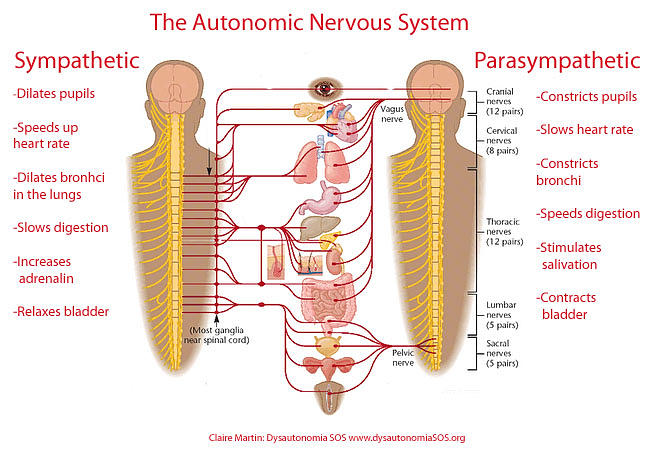
The ANS is made up of two subsystems: the sympathetic autonomic nervous system (SANS) and the parasympathetic autonomic nervous system (PANS). Most organs have nerves from both the sympathetic and parasympathetic systems.
The SANS usually stimulates organs. For instance, it increases heart rate and blood pressure when necessary. The PANS, on the other hand usually slows down bodily processes. For example, it reduces heart rate and blood pressure. There are certainly exceptions. Digestion and urination, for instance are stimulated by the PANS and slowed by the SANS.
The general responsibility of the SANS is to trigger emergency responses when required. These “fight or flight” responses get you ready to respond to stressful situations. The PANS, on the other hand, conserves your energy and restores tissues for ordinary functions.
Problems with the ANS can range from mild to life threatening. Sometimes only one part of the nervous system is affected. In other cases, the entire ANS is affected. Some conditions are temporary and can be reversed, while others are chronic and will continue to worsen over time. Diseases such as diabetes or Parkinson’s disease can cause irregularities with the ANS. Problems with ANS regulation often involve organ failure, or the failure of the nerves to transmit a necessary signal.
Symptoms of Autonomic Dysfunction
Effects of autonomic dysfunction can include just a small part of the ANS, or the entire ANS. Some symptoms that may indicate the presence of an autonomic nerve disorder include:
  • dizziness and fainting upon standing up (orthostatic hypotension)
  • inability to alter heart rate with exercise (exercise intolerance)
  • sweating abnormalities, which could alternately be too much sweat or insufficient sweat
  • digestion difficulties due to slow digestion. Resulting symptoms could include loss of appetite, bloating, diarrhea or constipation, and difficulty swallowing.
  • urinary problems. These can include difficulty starting urination, incontinence, and incomplete emptying of the bladder
  • sexual problems. In men, this could be difficulty with ejaculation and/or maintaining an erection. In women, this could be vaginal dryness and/or difficulty with orgasm
  • vision problems. This could be blurry vision, or the failure of the pupils to react quickly enough to changes in light.
Any or all of these symptoms may be present, and effects may be mild to severe.
Orthostatic hypotension or orthostatic intolerance (a milder form of orthostatic hypotension) are two of the most common conditions resulting from ANS disorders. Orthostatic intolerance, which results in low blood pressure on standing, causes alarming symptoms. These include lightheadedness, fainting, and heart palpitations.
Parkinson’s disease-like symptoms, such as tremor and muscle weakness, may also result from certain forms of autonomic dysfunction.

Causes of dysautonomia include:
  • Heavy metal poisoning (You can do the Hair Tissue Mineral Analysis in our centre to detect the heavy metal poisoning)
  • Autoimmune disorders including Sjögren's syndrome, lupus, sarcoidosis, Anti-NMDA receptor encephalitis
  • Parkinson's disease (in advanced parkinsonism or early in multiple system atrophy)
  • HIV and AIDS
  • Hereditary disorders including familial dysautonomia and Ehlers-Danlos syndrome
  • Chronic alcohol misuse
  • Some bacterial infections: (Lyme disease, tuberculosis, and Helicobacter pylori)
  • Spinal cord injury
  • Surgery or injury involving the nerves
  • Physical trauma or injury
  • Closed brain injury caused by asphyxiation, poisoning or encephalitis
  • Pure autonomic failure 
  • Amyloidosis 
  • Botulism
  • Diabetes mellitus 
  • Multiple sclerosis
Sympathetic nervous system-predominant dysautonomia is common in fibromyalgia, chronic fatigue syndrome, irritable bowel syndrome, and interstitial cystitis, raising the possibility that such dysautonomia could be their common clustering underlying pathogenesis.

Therapy for Autonomic Dysfunction | dysautonomia in Malaysia
1. Neuro-hypnotherapy 
Talking to the Amygdala: Expanding the Science of Psychological Hypnosis.
Recent brain research indicates that it is possible to talk to the amygdala, a key part of the brain that deals with certain emotions. The inner mind is concerned with emotion, imagination and memory as well as the autonomic nervous system which automatically controls our internal organs. By talking to the amygdala, an experienced clinical hypnotherapist can relax the autonomic nervous system shutting down, or curtailing the trigger that sets off secretion of the adrenal and pituitary glands. This gives the body an opportunity to rebuild its immune system in many chronic illnesses.
When a patient is in a hypnotic trance the amygdala automatically shuts down the rapid alert system and turns off the stress hormones epinephrine, cortocotropin, and glucocorticoids. The technique of relaxation through hypnosis has proven a highly effective tool in giving the body a chance to heal itself through its own inherent wisdom system. This is the part of the mind that knows how to make you breathe and send oxygen to your blood cells.

2. Biofeedback
The autonomic nervous system has two divisions which are the sympathetic and the parasympathetic. The sympathetic nervous system gets you up, gets you ready and gets you going, and regulates the flight/fight response. It gets you on the freeway, keeps you thinking about going to the doctor's office, or what kind of presentation you are going to make. The parasympathetic nervous system calms and relaxes you (when you lie down, take your break, go to sleep etc.), and manages body functions like digestion. The two work in tandem with each other in a reciprocal relationship. It was Canon and Selye, researchers in the body response to stress, who increased general awareness of the role of stress in physical diseases and mental disorders. Many of these manifested in disregulations of autonomic response.
Biofeedback is based on a principle known as “operant conditioning,” specifically positive reinforcement. Research has shown positive reinforcement increases the likelihood of a behavior and when a behavior is reinforced repeatedly and consistently over time, the behavior can be learned and retained. This is why the biofeedback treatment gains typically endure even after treatment ends. Biofeedback is frequently used to treat stress-related conditions, including high blood pressure, eating disorders, some anxiety disorders and certain types of headaches. It’s also used to help people learn how to relax more deeply. It’s most often performed by physicians, physiologists, kinesiologists (movement specialist) and psychologists, but it may also be done by other health-care workers

Contact me for more information regarding the Autonomic Dysfunction Analysis and Assessment in Malaysia.


Source:
http://www.hypnosisnetwork.com/articles/talking-to-the-amygdala-expanding-the-science-of-hypnosis#sthash.DYid9Ksv.dpuf
http://www.cbtinthecity.com/CBTblog/fibromyalgia-treatments-biofeedback-hypnotherapy-and-cognitive-behavioral-therapy-as-fibromyalgia-treatments/
http://www.healthline.com/health/autonomic-dysfunction#Overview1
http://www.christopherfisherphd.com/psychological-services/biofeedback/
https://en.wikipedia.org/wiki/Dysautonomia#Signs_and_symptoms

Friday, November 6, 2015

自律神经失调成因?


何謂自律神經失調

自律神經失調是用來形容一群難以用生理的原因去解釋的身體症狀。在精神科裡面,它與下列診斷相關:身體化疾患、未分化型身體疾患、疼痛疾患、恐慌症、廣泛性焦慮症、轉化症、解離症、慮病症、強迫症、心理因素影響或造成的醫學狀況、戲劇性人格、強迫性人格等。典型的症狀包括:頭痛、頭暈、胸悶、心悸、腸胃道不適、呼吸急促、冒汗、手腳發抖、肩頸肌肉酸緊、耳鳴、手腳發麻。症狀各式各樣,但這些診斷的共同特點是個案患有一些很困擾的非特異性身體的症狀,不斷地去做檢查都找不出病因。但是找不出病因,並不代表沒有原因,而是這些症狀大都跟心理壓力有關。

甚至有些生理的疾病,現在都已被認為跟心理因素是密切相關的:包括高血壓、氣喘、胃潰瘍、異位性皮膚炎、發炎性腸炎、甲狀腺機能亢進、風濕性關節炎、腸躁症等。

自律神經失調的成因

生理會影響心理,當然心理也會影響生理。很多疾病的產生,除了先天體質跟環境的交互作用之外,心理其實扮演很大的角色。首先我們要先瞭解壓力反應。當我們遇到急性壓力時,我們的大腦的杏仁核會先偵測到危險的刺激,透過交感神經系統發射訊號給我們的腎上腺髓質系統,因此腎上腺就會分泌腎上腺素及正腎上腺素,讓我們的血壓上升、心跳加快、肌肉收縮、腸胃道蠕動變慢,產生打或跑的反應,以應付外來的壓力。這是生物體求生存的一種本能及保護的機制。但是,一旦大腦不斷地偵測到壓力,就會進入慢性壓力的模式。這時候,我們的腎上腺皮質就會接手,分泌體內壓力荷爾蒙,就是所謂類固醇。類固醇會降低免疫力。因此當我們壓力大時,比較容易感冒。另外壓力荷爾蒙會不斷告訴大腦,現在還是處在危險的狀態。因此大腦會通知身體儲存脂肪以備不時之需。難怪,長期在慢性壓力之下的人,常會有厚厚一層的腰圍脂肪。特別是內臟脂肪跟心血管疾病及糖尿病相關。另外,大腦長期在壓力荷爾蒙的作用下,神經細胞會受損。一旦大腦生病了,我們的自律神經系統就會失調,憂鬱、焦慮及身體其他的疾病就會隨之而來。自律神經系統分為交感神經及副交感神經,交感神經會讓我們處在亢奮的狀態,好讓我們應付壓力;副交感神經則讓我們處在放鬆的狀態,可以讓細胞休息獲得養分。這套神經系統不是我們意識可以控制的,但它主管我們的呼吸、心跳及腸胃道蠕動。因此自律神經失調,最常見的症狀都跟這幾個器官系統有關。

除了外在壓力之外,另一種叫做內在壓力。每個人都會有內在的心理衝突,我們會有憤怒及性的慾望,這些都來自本我(Id)。但是自我(Ego)常常必須壓抑這樣的慾望,因為我們內在的超我(Superego)常不允許這樣的慾望出來。壓抑成功的話,就不會有症狀,但是如果壓抑失敗的話,就會出現症狀。這叫做內在衝突,既想要滿足慾望,但是又害怕實現自己慾望,因此就卡住了。A型人格,事事要求完美的人,就常讓自己處在高度壓力的狀態以及高度壓抑的人格,比如說敢怒不敢言、忍氣吞聲的人,都比較會產生所謂的內在壓力。


资料来源:http://www.tahsda.org.tw/newsletters/?p=76

Sunday, November 1, 2015

凭空出现的情绪?

午后天晴,喝了柠檬茶的我感觉好清爽。这情绪来自什么呢?
事实上,这可归咎自咖啡因(茶里有咖啡因)和血糖(蜜糖是高升糖食品)指数对情绪带来的变化。

我们常常不理解自己情绪的来源而懊恼不已,甚至不能够接受自己出现“不该有”的情绪。
事实上原生家庭问题,儿时因素,不理智想法,情景联结和条件反应或生理基因等因素都可衍生出种种情绪。情绪并不是凭空出现的。
许多时候,搞清为何有该情绪并不是最重要的。
权衡怎样处理之并带来良好生活品质或许更为实际。


Wednesday, October 28, 2015

Is Total Mind Control Possible?

Can hypnosis be used to make someone do something against his or her own will? This question has been the source of great controversy. I served as a consultant about hypnosis to Woody Allen’s film, The Curse of the Jade Scorpion, in which the character of Voltan uses hypnosis to get others to steal for him without recalling the event.
So, can hypnosis be used for mind control? 
There has certainly been a lot of research on the subject. The CIA and KGB have both experimented with hypnosis to create the perfect spy or even an assassin. But while I have read many stories about these experiments, I've never seen any proof of their success. Much may be possible in the dark and sinister underworld of spies and madmen, but university research on the possibilities has always been limited by ethics.
Could you be hypnotized and forced to do something illegal or diabolical? The general answer is that you cannot. There is a possibility, however, that if one had unlimited resources of money, power, and time, devious plans could be designed: There really were many secret experimental programs like "MK-Ultra" that used hypnosis and drugs to push mind-control to its limits. Is it possible that your friendly neighbor could have been implanted with a program to suddenly become a killer when "triggered" by the right signal?
What has been documented is that if you found a subject whose personality was deviant to begin with and wanted to direct their minds to do something extreme like plant a bomb or commit an assassination, you may be able to guide him or her to do it—with or without hypnosis. The hypnotic trance is a state of awareness that makes a person more easily persuaded. But the art of persuasion relies on many factors. To convince a normal person to become a killer is extremely unlikely. But if you are able to use coercion—such as kidnapping and threatening the life of their child—a person could very well be able to do anything to protect their offspring. Similarly, it may be possible to convince a person that something horrific will happen unless they follow your instructions precisely. Hypnosis could be used to plant such images, feelings, and stories in an innocent person who may then give in to the pressure and commit an attack they would otherwise never consider. 
You may have read in the spy novels about nefarious masterminds who use so-called “mind-control” techniques to program innocents to do their bidding like so many robots. And again, while this is unlikely, evildoers may be able to recruit the types of individual whose personality already is ready, if not eager, for violence, which could presumably include combat veterans who killed many enemy combatants in active duty. Perhaps this person also has strong philosophical leanings that following orders is correct, regardless of the consequences. If such a person volunteers for a covert project and enough time is spent applying all sorts of techniques to "reprogram" the subject, anything may be possible. Hypnosis could be used to promote a more complete mind reprogramming and solidify a specific plan with great detail—and create a hypnotized walking time-bomb.
Fortunately, there are not many people who are eager or willing to volunteer for such an experiment. There are also, however, many fanatics who do not need any additional persuasion to become assassins. We all know the madness of martyrs who become suicide bombers in the name of fanatical belief. We need hardly worry about someone using hypnosis to reprogram an individual to become a killer; there are enough individuals already eagerly seeking opportunities to inflict harm. 
You cannot be programmed to become killer without your knowledge. Hypnosis can be persuasive, but does not give the hypnotist control over your mind, morality, or judgment. So do not fear hypnosis—it should continue to develop as an effective technique to promote desired change in behavior, thinking, and emotions (without shifting to mind-control). It's a powerful tool and we should use it for beneficial purposes, not evil intentions. 

All retrieved from:
https://www.psychologytoday.com/blog/hypnosis-the-power-trance/201509/is-total-mind-control-possible?utm_source=FacebookPost&utm_medium=FBPost&utm_campaign=FBPost

Monday, October 26, 2015

【我的少女時代 Our Times】观后感

最近听说在台湾制作的【我的少女時代 Our Times】好评如潮,于是抱着好奇的心去观赏了这部电影。 


我个人认为这部电影里头人物的心理发展建构得很写实,也善用了亲和感(rapport),呼应(pacing)和镜像术(Mirroring)的催眠原理。善于运用这些手法,确实能成功勾起我们潜意识里的情绪。 当我们情绪随着剧情达到高峰点时,电影里开始播起舒服调调的主题曲“小幸运”,确实能在我们心里造成个心瞄(anchoring)。这或许就是为何我们每次听到这首歌曲就不自觉勾起潜意识里的情绪反应。一直想要重播这首歌曲,去勾起潜意识里那悸动的情绪。

最让我印象深刻的就是男主角因为好友逝世而性情大变的情节。当一个人的情绪无法得到适当的宣泄,会在心理形成一个伤口,或许就是如此造成了反叛的个性。一个人在无法原谅自己的情况下(内疚),变得反叛再让人责备这补偿效应比起让他接受自己那内疚的情感来得容易许多。这行为其实并不出奇,许多人在现实生活中都会运用简单快速的补偿方法来“解决心理的情绪问题”。就如一个人心情不好,与其寻找适当方法来应对内心的情绪,大部分的人都会运用简单快速的方法来暂时麻木情绪;如睡觉或大吃大喝这种补偿效应。

看似自信的徐大宇,其实被内疚这情绪反应折磨得很痛,实在让人看了心疼。
然而现实生活中,我们身边有许多人被情绪所扰从而个性被扭曲。如果你们去了解他们的故事,你也会有不同的见解。

总结来说,我觉得拍摄手法有非常好的运用了心理学与催眠的原理,是很用心的创作。

*纯属个人意见和以催眠角度来分析该电影。绝对尊重制片人的用心和创意。


那什么是临床催眠疗法?
脑科学研究证明,大脑前额叶不仅与意识和思维等心理活动有关,而且前额叶与调节内脏器官活动的下丘脑之间也存在着紧密的纤维联系。这种结构上的联系可能是人类能主动利用意识和意象来调节和控制内脏生理功能的主要物质基础。潜意识对调节和控制人体的呼吸、消化、血液循环、免疫反应、物质代谢以及各种反射和反应均起着很大作用。许多研究证明,在催眠状态下暗示身体处于不同状态,代谢率就出现相应的变化。如催眠暗示正在从事重体力劳动时,代谢率可上升25%,应用自体发生训练法进行自我催眠,使心身放松后,代谢率比平时的安静状态降低15~20%。因此,在催眠状态下,根据强化的原则,自己不断地强化积极性情感、良好的感觉以及正确的观念等,使其在意识和潜意识中印记、贮存和浓缩,在脑中占据优势,就可以通过心理生理作用机制对心身状态和行为进行自我调节和控制。


催眠时的脑电波状态?
催眠时脑波主要呈现ALPHA状态。ALPHA脑波在8至14赫兹,ALPHA脑波在优势脑波时,人的意识清醒,但身体却是放松的,它提供意识与潜意识的桥梁,由于在这种状态下,身心能量耗费最少,相对的脑部获得的能量较高,运作就会更加快速,顺畅,灵感及敏锐。脑的活动活泼,现代科学积极倡导ALPHA脑部视为人们学习与思考的最佳脑部状态,道理就在于此。慢速ALPHA脑部频率在8至9赫兹,多见临睡前茫茫然的状态,意识逐渐走向模糊。中间ALPHA脑部在频率9至11赫兹,多见点子或灵感发挥威力的状态,身心集中而注意力集中。快速ALPHA脑部频率在12至14赫兹。


部分资料来源:
http://baike.baidu.com/view/41417.htm

Sunday, October 25, 2015

[Corporate Health Talk on Stress Management] Group Hypnotherapy Session at Lonpac Insurance Bhd


 Group hypnotherapy session to relieve stress
Yes, you can train your brainwaves like a muscle!
"Ubah frekuensi gelombang otak" by using neuro-hypnotherapy training method.
I mentioned about this concept in newspaper before.


                       Chinese Physician was sharing how to use therapeutic massage to reduce stress.

 Naturopath was sharing how to reduce stress by using the concept of nutritional therapy.
She shared similar nutritional therapy tips on 8TV program too.

Health Talk conducted in English at Lonpac Insurance Bhd.


Health Talk Topic:
Stress Management tips from Clinical Hypnotherapist, Chinese Physician and Naturopath.

Speakers:
Esther Peh, President of Naturopathic Medical Association Malaysia 
Hiro Koo, Clinical Hypnotherapist 
 Madam Low, Chinese Physician


Group Activities:
1) Group hypnotherapy session 
2) Therapeutic massage DIY session
3) DIY juice therapy
4) Brain assessment for understanding your stress, focus and attention abilities

Contact us if you are interested. 

Saturday, October 24, 2015

[Corporate health talk] Simple Ways To Live a Longer and Happier Life in Mandarin for Rin Enzyme (JB)

今天来到了柔佛州的新山,以临床催眠师的身份到我的家乡进行身心健康讲座会。
此次和我同行的有中医师Miss Low。
主要是要向Rin Enzyme的消费者们推广饮食身心与长寿之间的关系。

In such busy lifes we are living, we have too much stress, too little exercise, poor diet with food that consist of saturated fat, sugar and very little fiber. An alternative to balancing your body systems is to take RIN Enzyme which is able to help you prevent heart diseases and strokes.
Enzyme即酵素。
思考问题、运动、睡眠、呼吸、愤怒、哭泣、又或者,消化食物、分泌荷尔蒙、血液运行、促进细胞的成长,所有的都是以酵素为中心活动的结果。不仅仅是我们(人类),还有地球上所有的生命物质,在发生酵素活动反应(酵素作为催化剂而引起的反应)现象的基础上,存活成立是最好的 。

要维持良好的自律神经系统与预防身体处于不佳的亚健康状态,除了身心的照顾,酵素的摄取也是很重要的一环。


现场超过一百名的客户,对身心健康有非常浓厚的兴趣。
相信是如此,这才愿意在休息日抽空出席我们的健康讲座。
大家在两小时内对营养学,中医学和心理学对长寿的影响有了初步的理解。
也学了我所教授的“无针针灸解压法”,作为自律神经的保养动作。
有者甚至因为迟到而错过了我们的教学,为此而后悔不已。
许多观众还要求我们通知他们出席下一场的讲座呢!
听到这番话,让我安慰许多。


最近的烟雾对我的呼吸系统造成了伤害,抱病演讲是个挑战。
辛亏观众反应不赖,也有认真的学习我所分享的知识,让我松了口气:)
讲座会后,我们也为现场观众进行了脑波检测,让他们了解他们的大脑自律神经失衡状态。
短短5分钟,大家对自己的身心状态有了更深一层的认识。这也让大家纷纷称奇。
错过此次演讲的,下个月还有一场会在吉隆坡KL举行哦!


针灸对身心有帮助吗?当然有的!而且有科学研究证实哦:
http://www.healthcmi.com/Acupuncture-Continuing-Education-News/1244-acupuncturebraincellgb34du20
New lab experiments reveal acupuncture has antidepressant effects!
这真的是振奋人心的消息!我和综合中心里的中医们紧密合作,看见许多面对抑郁问题的客户在接受中医针灸和脑波催眠疗法后得到很好的良好反应。这科学研究再次证实了中医针灸确实可以帮助心理问题。


 工作不忘休闲,我们来到了JB著名海鲜村。
接下来就是慰劳时刻咯!
期待再次受到邀约,让我可以再回来我的家乡分享心灵健康实用小知识。

Health Talk conducted in Mandarin for Rin Enzyme (JB)

Health Talk Topic:
Simple Ways To Live a Longer and Happier Life

Speakers:
Hiro Koo, Clinical Hypnotherapist
 Miss Low,  Chinese Physician


Group Activities:
1) EFT ('acupuncture without the needles') for stress management
Conducted by Hiro Koo

Contact us if you are interested. 


Wednesday, October 21, 2015

脑波自律神经失调检查服务EEG biofeedback and autonomic dysfunction (dysautonomia) assessment

What is Dysautonomia or Autonomic Dysfunction? 

Dysautonomia or Autonomic Dysfunction is an umbrella term used to describe several different medical conditions that cause a malfunction of the Autonomic Nervous System. The Autonomic Nervous System controls the "automatic" functions of the body that we do not consciously think about, such as heart rate, blood pressure, digestion, dilation and constriction of the pupils of the eye, kidney function, and temperature control. People living with various forms of dysautonomia have trouble regulating these systems, which can result in lightheadedness, fainting, unstable blood pressure, abnormal heart rates, malnutrition, and in severe cases, death. Dysautonomia is not rare. Over 70 million people worldwide live with various forms of dysautonomia. People of any age, gender or race can be impacted.
2 Parts of the Autonomic Nervous System The autonomic nervous system, also known as the involuntary nervous system, regulates those facets in the body that occur automatically, such as breathing, blood pressure, digestion, heart beat, bladder function and narrowing or widening of the blood vessels. It is composed of two branches - the parasympathetic nervous system and the sympathetic nervous system.

Sympathetic 
The sympathetic nervous system is also known as our stress response system, or the fight or flight system, and it is set into motion when we experience stress. It increases our heart rate and blood pressure, dilates pupils, restricts circulation, slows down digestion, relaxes the bladder, makes us more alert and aware and provides a boost in energy so that we are capable of dealing with the stressful situation effectively. It increases energy and is often referred to as the accelerator of the autonomic nervous system.

Parasympathetic 
The job of the parasympathetic nervous system is the exact opposite. Once the stressful event is over, it brings the heart rate and blood pressure back to normal, constricts pupils, improves circulation, enhances digestion, calms us down, contracts the bladder and puts us into a state of rest and relaxation. It conserves energy and is often referred to as the breaks of the autonomic nervous system.
What Causes Dysautonomia or Autonomic Nervous System Dysfunction? 
When the autonomic nervous system is functioning as it should, the sympathetic nervous system and the parasympathetic nervous system work in perfect harmony together to maintain balance in the body. The sympathetic nervous system provides us with the tools we need to respond to stress adequately and the parasympathetic nervous system restores us to our normal state of peace and tranquility. Dysautonomia, or autonomic nervous system dysfunction, occurs when these two systems fail to work together in harmony. The most common scenario is the sympathetic nervous system remains dominant most of the time and the parasympathetic rarely turns on, which is referred to as sympathetic dominance. When this occurs, then the body remains in a state of fight or flight most of the time or at all times. The stress response system never or rarely turns off. If the body remains in a state of fight or flight all the time, then many degenerative processes begin to happen and result in a variety of chronic health conditions and overall poor health like those in our list above, because it is only supposed to be used for brief emergencies.

Our assessment services for the Dysautonomia or Autonomic Dysfunction:
EEG biofeedback and autonomic dysfunction (dysautonomia) assessment 
The fight-or-flight response activates the sympathetic portion of the autonomic nervous system resulting in numerous physiological and mental alterations. Activation of the sympathetic nervous system was able to be quantitatively measured using EEG biofeeedback.

ES-Teck assessment
The ES-Teck assessment is not a diag­nos­tic tool. This device gives health care providers and their clients invalu­able infor­ma­tion by allow­ing them to mea­sure and mon­i­tor var­i­ous char­ac­ter­is­tics of the body’s physiology. Using a finger “Oximeter” it allows for observation of heart rate, tissue oxygen uptake, arterial stiffness, hemodynamic indicators and autonomic nervous system (ANS) levels of activity. Gives health care providers and patients invaluable information by allowing them to measure and monitor various characteristics of the body’s physiology and autonomic nervous system conduction.


可否听说过自律神经失调?通常有自律神经失调症状的人,在經過各種儀器檢查出來都很正常并查不出病因的。 面对自律神经失调的人,严重者甚至会有“逛医院或诊所(即不停的找寻病源但无法找着)”的问题。

自律神經失調並不是一種病,而是一系列的症狀,也就是症候群,病因可能有許多種,也有許多種疾病會出現這些症狀,例如抑郁症depression、恐慌症panic attack or anxiety disorder等等。因為針對的器官不同,可能出現以下某些症狀:
1)倦怠、
2)口乾、
3)心悸、
4)頭暈頭痛、
5)焦慮恐慌、
6)心律不整等、
7)姿態性低血壓、
8)呼吸急促、
9)胃痛、
10)头疼、
11)腹脹、腹鳴、腹瀉、泻肚子或便秘等不止。

 基本上,幾乎全身都有自律神經分布,所以症狀也相當多樣。


這裡將自律神經失調分成2種,快快了解成因,改善自律神經失調,告別沒有朝氣的自己! 交感神經讓你活動: 當身體需要活動、抗壓時,就是交感神經活躍的時候。這時心臟、肺的作用力大幅提升,體溫與血壓也跟著上升,調整身體狀態,使你精神飽滿,又能燃燒體脂肪!此時消化與排泄作用則會進入休息狀態。

交感神經活躍時的狀態: 
★大腦活動旺盛 - 快速處理接收的情報,掌管心臟與肺臟。 
★不易有睡意 - 腎上腺素分泌抗壓荷爾蒙,提高大腦與身體的活動量,不易有睡意。 
★心跳加快,血壓上升 - 加速心臟跳動,將身體活動所需的充足血液,送到身體各器官。 
★消耗熱量 - 交感神經運作,消耗熱量,燃燒體脂肪! 
★支氣管擴張 - 支氣管擴張,呼吸次數增加,將大量空氣送入肺中,提供新鮮酵素。 
★子宮收縮 - 交感神經活躍時,子宮會收縮,例如生產時收縮子宮,將小Baby順利產出。 
★抑制胃酸分泌 - 心與肺活動時,腸胃不須有太大活動,所以會抑制胃酸分泌,以利能量釋放。 
★腸胃蠕動變慢 - 使排便暫緩、腸胃蠕動變慢,持續強烈緊張而便秘時,就是交感神經過度興奮。
 ★不易排尿 - 身體活動時,必須讓環境穩定,抑制排尿則可以變得更有效率。 副交感神經讓你放鬆: 副交感神經會舒緩緊張,放鬆身體,受到交感神經的刺激,減緩心臟與肺的活動力,使胃腸活動旺盛,促進消化吸收,將不需要的物質以尿液或汗排出。 尤其在睡眠時,活動力更是旺盛! 

副交感神經活躍時的狀態: 
★大腦呈休息狀態 - 大腦進入休息狀態,使全身放鬆。 
★心臟跳動減緩,血壓下降 - 休息時不需要太多血液,所以心跳減緩,血壓下降。 
★支氣管收縮 - 在休息狀態中,身體不需做劇烈活動,所以也不須要太多空氣。 
★腸胃蠕動旺盛 - 腸胃蠕動旺盛,就能將老廢物質排出體外,在放鬆狀態容易想要排便,就是這個緣故呢! 
★刺激生長激素 - 副交感神經活躍,刺激肌膚等的新陳代謝,使生長激素分泌旺盛。 
★舒緩子宮緊張 - 使肌肉休息,舒緩子宮緊張,例如抑制子宮收縮,讓小Baby可以在子宮中長大。 
★分泌胃酸 - 副交感神經活躍,是為了儲存能量,於是胃的活動大增,胃酸分泌增多。 
★容易排尿 - 副交感神經活躍,膀胱收縮,刺激排尿作用,將老廢物質排出體外。 交感神經與副交感神經,為使每天的必要性活動能執行,不斷地做轉換,使身體保持最佳狀態! 不過,壓力過大,交感神經會持續過度興奮狀態;過度疲勞,副交感神經同樣也會有過度興奮情形產生,当2種神經無法順利轉換,平衡失調。失調的情況持續下去,副交感與交感神經都會因為活動過盛,而感到疲倦,到最後一點幹勁也沒有,身心俱疲,便會產生抑郁depressed狀態。


脑波检测服务 EEG biofeedback assessment让你更了解你的大脑状态:
透过脑电波,我们可以看见肉眼察觉不到的身心状态。精密测量脑电波,对觉醒活动必需的休息、注意力、集中力等三种状态进行神经反馈测试,从而对大脑的自律神经系自我调节能力进行科学的分析,正确了解活动中的大脑功能。这能让我们更了解自己大脑的自律神经是否操作顺利。透过脑电波Delta, Theta, Alpha, Beta, Hi-Beta的呈现状态,我们能够更了解你目前的脑波状态是否属于亚健康。我们中心提供脑波检测服务,有兴趣就尽快联络我们,了解更多检测详情吧!


Source:
http://www.dysautonomiainternational.org/page.php?ID=34
http://www.dysautonomiainternational.org/images/ImageCredit.png
http://www.holistichelp.net/dysautonomia-autonomic-nervous-system-dysfunction.html

Tuesday, October 13, 2015

The surprisingly dramatic role of nutrition in mental health


Here’s a remarkable TEDx talk that’s well worth sharing!
Nutrition researcher Dr. Julia Rucklidge, a Clinical Psychologist at the University of Canterbury, NZ gives compelling evidence for the critical role of nutrition in mental health and explains why this knowledge will revolutionize the way our society treats ‘mental illness’!

For more than a decade, Dr. Rucklidge has played a key role in forefront nutrition-mental health research, including extensive research using products formulated by Hardy Nutritionals® Founder David Hardy. A recent scientific article in BMC Psychiatry noted that there is “more published and ongoing research on [Hardy’s] formula for mental health than on any other complex formula anywhere in the world.”

Dr. Rucklidge recently published a double blind study in the British Journal of Psychiatry which showed that those taking Hardy’s nutrient formula experienced “statistically robust improvements” over those taking placebo. For example, the adult participants taking the nutrients reported more than double the improvement in ADHD symptoms (including attention, hyperactivity, and impulsivity), compared with participants taking placebo. Dr. Rucklidge is currently conducting a double-blind study using Hardy’s newest formulation, Daily Essential Nutrients, in children diagnosed with ADHD.


Source:
https://www.youtube.com/watch?v=3dqXHHCc5lA